The Question AI Can't Answer for Your PMO
AI now handles PMO scheduling, reporting, and risk detection. This article breaks down what's left for PMOs to decide, and why that's still the hardest part.
If AI can build schedules, summarize project updates, detect delivery risks, and predict delays, what is left for the PMO to do?
It is a fair question. Many tasks that once required hours of coordination are becoming easier to automate. But identifying a problem is not the same as deciding what to do about it.
AI may show that a critical project is likely to miss its deadline. It cannot decide whether to reduce scope, move resources, renegotiate a commitment, or accept the delay.
The real question is not whether AI will change the PMO. It is where PMO value moves once detection becomes easier.
What AI Is Already Good At
AI is already becoming useful in the parts of project management that depend on processing large amounts of information quickly.
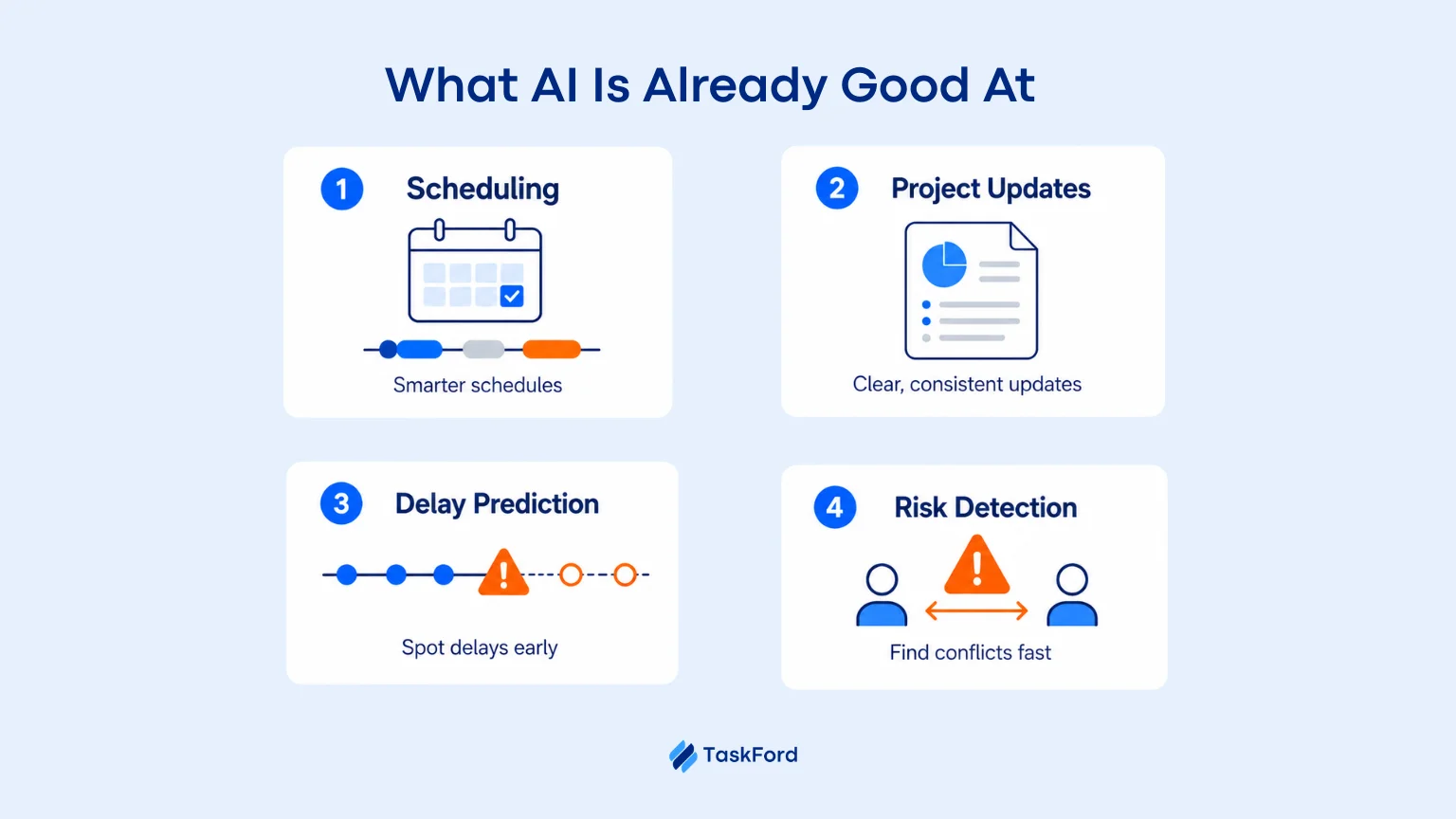
1. Building More Realistic Schedules
AI can look across workloads, deadlines, and dependencies at the same time. It can identify scheduling conflicts before they cause delays and suggest adjustments when plans change.
2. Turning Updates Into Clear Project Status
AI can pull updates from different tools, summarize progress, and prepare status reports without someone having to chase every team for an answer.
3. Predicting Delays Earlier
AI can compare a project’s current pace with previous performance and similar projects. This helps it flag a likely delay while there is still time to respond.
Related read: AI in Project Planning - How Intelligence Improves Forecast Accuracy and Delivery Predictability
4. Detecting Risks Hidden in the Details
AI can connect signals that are easy to miss when viewed separately: two projects competing for the same specialist, an overlooked dependency, or a workload that has quietly exceeded one person’s capacity.
This is no longer theoretical. More than a third of organizations with a PMO already use AI-supported practices, according to PM Solutions’ State of the PMO 2025. Among high-performing PMOs, that figure rises to 61%. The difference suggests that stronger PMOs are not waiting for AI to become a future capability. They are already using it to improve how quickly they see what is happening across their portfolios.
All four of these are pattern questions: What is changing? Where is pressure building? Is the work still on track? Give AI enough reliable data, and it can find those patterns quickly.
But finding the pattern is not the same as knowing what to do about it. That’s the next part.
What Detection Does Not Do
Here is where it gets interesting.
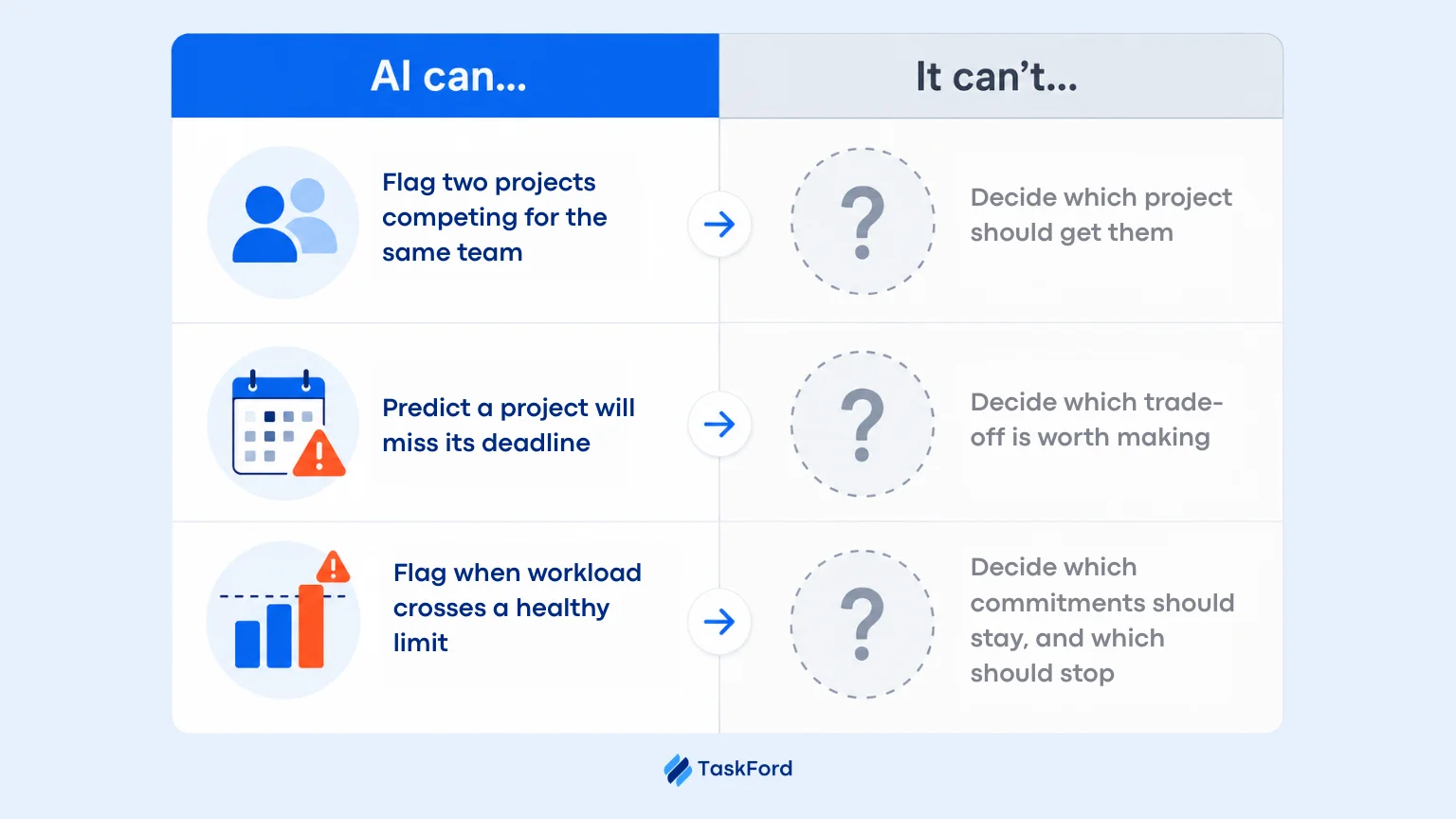
AI can identify that two projects will compete for the same three engineers next month, and even show which deadlines are likely to move. It can’t tell you which project the organization should prioritize.
AI can predict that a project is likely to miss its deadline and model what happens if you cut scope or add support. It can’t tell you which trade-off the organization should accept.
AI can flag that someone’s workload has exceeded a healthy limit and show where the pressure is coming from. It can’t tell you which of their commitments should stay, and which should stop.
Those decisions depend on context that project data doesn’t fully capture: which client relationship matters more right now, which commitment was already made to a board, which team can absorb a delay without falling apart. That context lives in conversations, not in data.
This is the actual line. AI is very good at telling you something is happening. It has no way of telling you what to do about it. That gap is not a flaw in the technology. It’s the part of the job that was always the point.
Why This Shift Is Happening Now
This isn’t happening because AI got smarter for its own sake. It’s happening because the conditions PMOs work under have changed.
Teams run more projects at once than they used to, often with the same people spread across all of them. Priorities shift mid-quarter more than they used to. And leadership expects a clear answer to “where do we stand” faster than a weekly status meeting can provide.
Manual tracking was never built for that pace. It worked when a PMO managed a handful of projects with stable teams. It struggles when the same person is on four projects that all changed scope this month.
AI didn’t create that pressure. It’s a response to it. The tools got better at the exact moment the old way of tracking stopped keeping up.
That’s also why this isn’t really a story about AI replacing PMOs. It’s a story about what counts as valuable work changing, because the slow, manual version of tracking is no longer good enough to run on.
The Questions That Change in the AI Era
As AI gets better at monitoring projects, the PMO has to focus less on what’s happening and more on what the organization should do next.
1. From “Are Projects on Schedule?” to “Are We on the Right Projects?”
A project can be on track and still no longer support the organization’s current priorities. Keeping work moving is not enough if that work is no longer worth the time, capacity, or investment it requires.
2. From “Who Is Overloaded?” to “What Should We Stop?”
AI can identify who’s overloaded down to the hour. But moving tasks from one person to another does not solve the problem if every request remains urgent. The PMO must help the organization decide which commitments still deserve resources.
3. From “What Is the Risk?” to “Who Needs to Decide?”
Identifying a risk is only useful when someone has the authority and responsibility to respond. The PMO must clarify who needs to know, what decision is required, and what happens if no action is taken.
4. From “How Utilized Are We?” to “Are We Investing in the Right Work?”
High utilization looks good on paper, but being busy isn’t the same as being useful. The better question is whether that time is going toward what matters most, not just what got approved first.
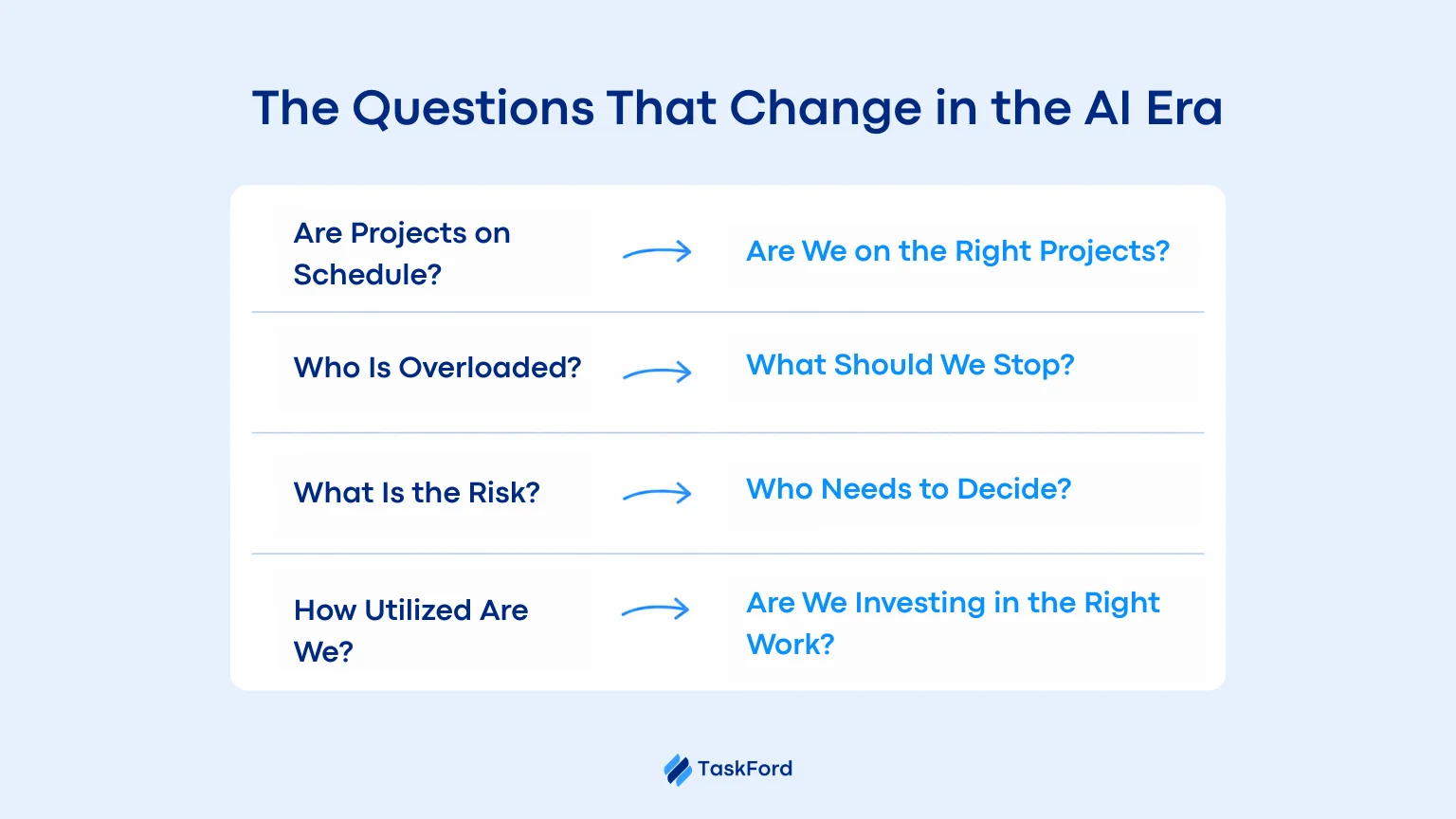
These four shifts all need the same thing: context, judgment, and a willingness to make trade-offs. The future PMO spends less time proving work is moving, and more time deciding whether it’s worth moving at all.
Why the Same AI Performs Differently Across PMOs
Two PMOs can buy the exact same AI tool and get completely different results. That’s the most common outcome right now.
Gartner’s research on AI-driven portfolio management found that only 24% of PMOs have successfully adopted AI for their project, program, or portfolio work, even though far more have tried. The gap usually comes down to one thing: what the AI is allowed to see.
An AI tool built to catch scheduling conflicts can only check the schedules it has access to. If half the team’s workload lives in a spreadsheet and the other half lives in someone’s inbox, the AI isn’t wrong when it misses a conflict. It’s just working from half the picture, and it will still sound confident.
That’s the real risk. These tools rarely fail loudly. They fail quietly, by giving a clean answer built on incomplete information, and a confident wrong answer is harder to catch than an obvious gap.
The PMOs getting real value from AI aren’t the ones with the newest tools. They’re the ones where planning, workload, progress, and cost already sit in one place, so the AI has a full picture to work from. The tool matters less than what it’s allowed to see, which is often the real problem behind AI tool sprawl rather than a reason to buy more of it.
So, What Is Left for the PMO to Do?
Take away the tracking, the reporting, the schedule math. What’s left is the part that was always the hardest: deciding.
Right now, most PMOs still measure themselves by activity. How many status reports went out. How many trackers stayed updated. But according to PMI research, only 36% of organizations fully realize the benefits they expected from their projects, and just 34% deliver on time and within budget. That gap doesn’t close by tracking harder. It closes when someone with the authority to decide actually gets the information in time to act on it.
That’s the real shift here. PMOs aren’t losing relevance. What’s disappearing is the part of the job that only looked like value: the reports, the dashboards, the meeting notes. None of that was ever the actual value. It just led up to it. A status report only mattered because it told someone what to do next. Now that AI can write that report in seconds, the only part still left for a person to do is make that call.
In practice, this comes down to one thing: who’s allowed to decide, and by when.
- A PMO that says “we’ll flag it and let leadership figure it out” is still operating in the old model.
- A PMO that says “when two projects compete for the same team, here’s who decides, and here’s the deadline for deciding” has moved into the new one.
Same problem, same information. The difference is that one PMO has clarity about who owns the decision, and the other doesn’t.
That’s a smaller job than the one PMOs used to have, in terms of hours. It’s a harder one in terms of what it demands: judgment, timing, and the willingness to make a call instead of just surfacing the option. AI didn’t take that away. It just made it impossible to hide behind reporting instead of doing it.
Conclusion
Go back to the question this started with: if AI can build schedules, summarize updates, detect risks, and predict delays, what is left for the PMO to do?
By now the answer should be clear. What’s left is everything AI was never going to touch: deciding what matters, owning the trade-off, making the call when the data runs out and judgment has to take over. That was never the easy part of the job. It was always the point of it.
So here’s the one question worth sitting with: if AI took over every report and every tracker update tomorrow, would your PMO have anything left to decide, or would it just have less to report?
Related Articles








Subscribe for Expert Tips
Unlock expert insights and stay ahead with TaskFord. Sign up now to receive valuable tips, strategies, and updates directly in your inbox.