AI Adoption in Professional Services: Statistics, Trends, and Business Impact in 2026
the latest 2026 AI adoption statistics, trends, use cases, and business impact across professional services firms.
Somewhere right now, a consultant is asking ChatGPT to summarize a meeting that could have been an email. That’s AI adoption in professional services in 2026.
And it’s growing fast. In 2025, 27.1% of professional services projects used generative AI, up 40% from the year before.
But there’s a number that doesn’t fit the story. Billable utilization fell to 66.4%, the lowest on record. Teams have more AI than ever, yet they’re spending less of their time on work clients actually pay for.
So is AI making projects better, or just making the busywork faster?
In this article, we look at both sides: how quickly firms are adopting AI, and what it’s actually doing to utilization, margins, and profit.
AI Adoption in Professional Services: Key Statistics at a Glance
AI use is growing fast, but the rest of the scorecard tells a more mixed story. Here are the numbers from the latest industry benchmark, side by side.
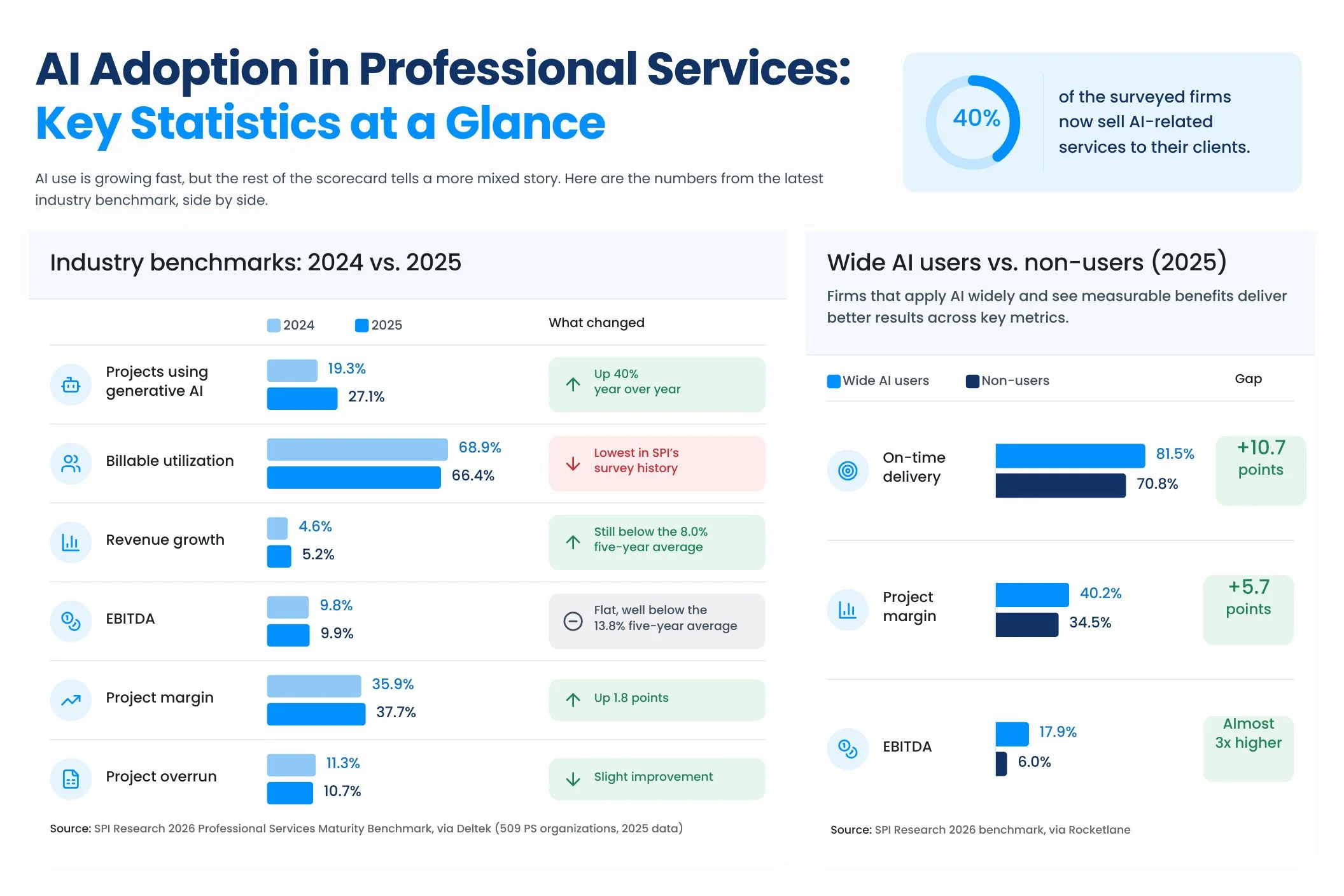
Industry benchmarks: 2024 vs. 2025
| Metric | 2024 | 2025 | What changed |
|---|---|---|---|
| Projects using generative AI | 19.3% | 27.1% | Up 40% year over year |
| Billable utilization | 68.9% | 66.4% | Lowest in SPI’s survey history |
| Revenue growth | 4.6% | 5.2% | Still below the 8.0% five-year average |
| EBITDA | 9.8% | 9.9% | Flat, well below the 13.8% five-year average |
| Project margin | 35.9% | 37.7% | Up 1.8 points |
| Project overrun | 11.3% | 10.7% | Slight improvement |
Source: SPI Research 2026 Professional Services Maturity Benchmark, via Deltek (509 PS organizations, 2025 data)
AI isn’t just an internal tool anymore. 40% of the surveyed firms now sell AI-related services to their clients.
Wide AI users vs. non-users (2025)
SPI also compared firms that apply AI widely and see measurable benefits with firms that do not use AI:
| Metric | Wide AI users | Non-users | Gap |
|---|---|---|---|
| On-time delivery | 81.5% | 70.8% | +10.7 points |
| Project margin | 40.2% | 34.5% | +5.7 points |
| EBITDA | 17.9% | 6.0% | Almost 3x higher |
Source: SPI Research 2026 benchmark, via Rocketlane
What the numbers tell us
AI saves time, but that time isn’t becoming billable work. More projects use AI, yet utilization hit a record low. The time AI frees up seems to go into internal work, learning new tools, or waiting for the next project. With revenue growth still below average, many firms simply don’t have enough client demand to fill those extra hours.
Firms earn more from the hours they do bill. Project margin and revenue per consultant both went up while utilization went down. AI’s value is showing up in margins, not in hours.
Those project gains aren’t reaching the bottom line. Margins rose, but EBITDA stayed flat. Overhead, tool costs, and non-billable time are eating the gains before they turn into profit.
How deeply you use AI matters more than whether you use it. Wide AI users deliver on time more often and earn almost 3x the EBITDA of non-users. Industry averages look flat because most firms are still in between, testing AI on a few projects without changing how they work.
⚠️ Note
These numbers show a link between AI use and better results, not proof that AI caused them. Firms that were already well run may adopt AI faster and use it better. Either way, the gap is real.
💡 Tip
If you bill by the hour, AI can work against you. Finish a task in half the time and you bill half as much. Fixed-fee or outcome-based pricing lets you keep the time you save as margin, so check how your pricing model handles faster delivery.
How Fast Is AI Adoption Growing in Professional Services?
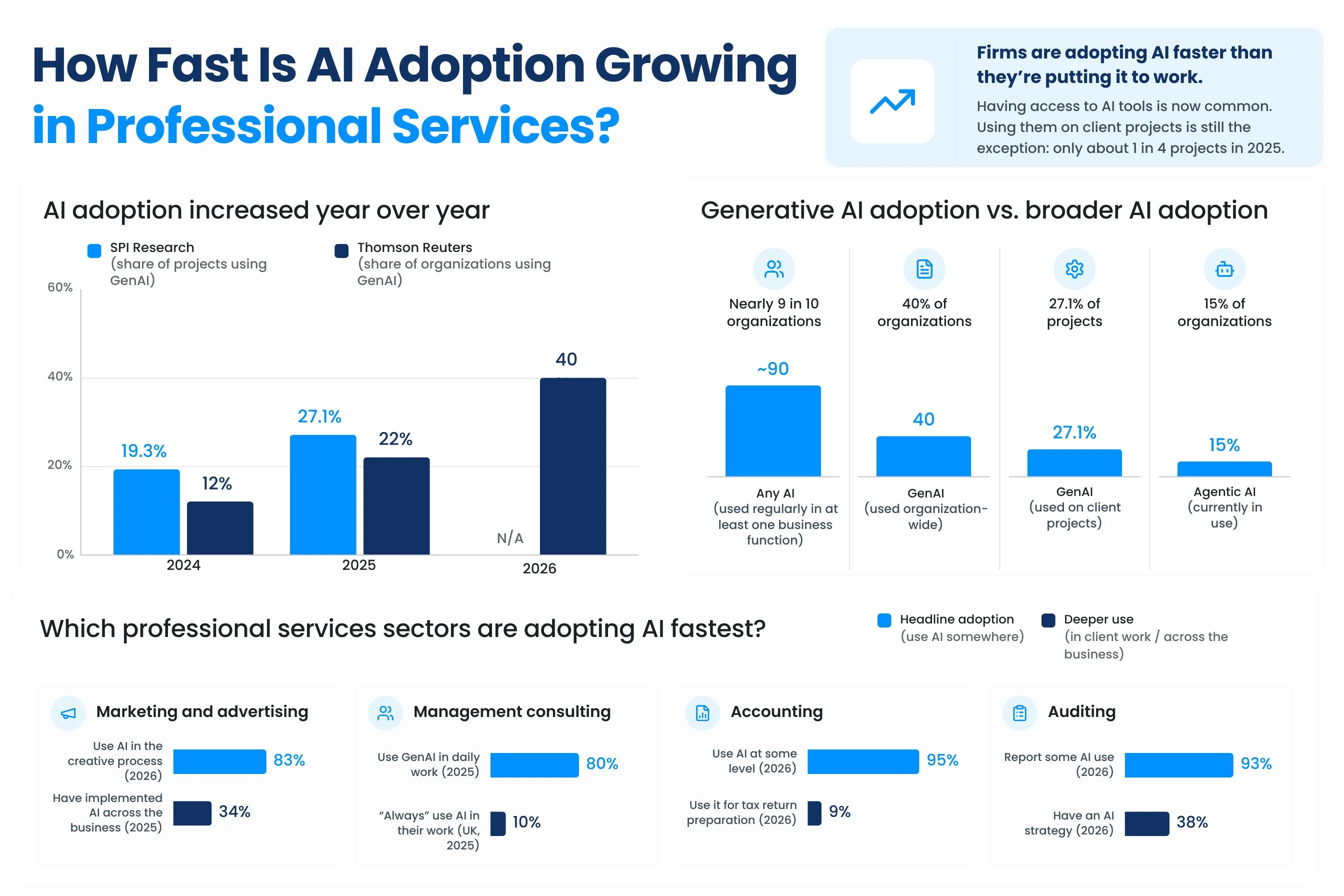
Fast. Depending on which survey you read, AI use in professional services has nearly doubled every year since 2024. But “adoption” means different things in different reports, so it helps to look at what each number actually measures.
AI adoption increased year over year
Two major surveys track AI use in professional services, and both point the same way.
| Source | What it measures | 2024 | 2025 | 2026 |
|---|---|---|---|---|
| SPI Research, 509 PS organizations | Share of projects using generative AI | 19.3% | 27.1% | Not yet published |
| Thomson Reuters, 1,500 to 1,800 professionals per year (2025, 2026) | Share of respondents whose organization actively uses GenAI | 12% | 22% | 40% |
On the SPI side, project-level use grew 40% in one year. Thomson Reuters shows organization-wide use nearly doubling twice in a row, from 12% to 22% and then to 40%.
That gap is the real story. Firms are adopting AI faster than they’re putting it to work. Having access to AI tools is now common. Using them on client projects is still the exception: only about 1 in 4 projects in 2025.
Generative AI adoption vs. broader AI adoption
GenAI is the part of AI most professionals actually touch day to day. Broader AI, including agentic AI that carries out tasks on its own, is much less common.
| AI type | Adoption | Population and year |
|---|---|---|
| Any AI, used regularly in at least one business function | Nearly 9 in 10 organizations | McKinsey, 1,719 respondents across all industries, 2026 |
| GenAI, used organization-wide | 40% of organizations | Thomson Reuters, 1,500+ PS professionals, 2026 |
| GenAI, used on client projects | 27.1% of projects | SPI Research, 509 PS organizations, 2025 |
| Agentic AI, currently in use | 15% of organizations | Thomson Reuters, 1,500+ PS professionals, 2026 |
Thomson Reuters also found that in 2026, for the first time, most individual professionals use publicly available GenAI tools such as ChatGPT. Another 53% of organizations are planning or considering agentic AI tools.
A couple of things stand out:
- Professional services are behind the wider market. Almost every organization uses AI somewhere, but only 40% of PS organizations use GenAI across the whole business.
- People are ahead of their firms. Most professionals already use public GenAI tools on their own, often before their firm has an official tool or policy.
- Agentic AI is the next wave, but it’s early. At 15% adoption, it’s where GenAI was a couple of years ago.
Read also: Top 10 Professional Services Automation Software in 2026
Which professional services sectors are adopting AI fastest?
Marketing and advertising is furthest ahead, accounting and auditing is climbing fastest, and management consulting is enthusiastic but uneven. Across all three, the same pattern shows up: nearly everyone uses AI somewhere, but far fewer use it on the work clients actually pay for.
At a glance
| Sector | Headline adoption | How deep it goes | Source and population |
|---|---|---|---|
| Marketing and advertising | 83% of ad executives say their company uses AI in the creative process, up from 60% | 34% of digital agencies have implemented AI across the business | IAB, 104 US ad executives, 2026; Promethean Research, 119 agency leaders, 2025 data |
| Management consulting | 80% of management consultants use GenAI in their daily work | Only 1 in 10 UK consultants “always” use AI | LexisNexis, 2025; Deltek Clarity UK Study, 2025 |
| Accounting | 95% of accounting and bookkeeping professionals use AI at some level | Only 9% use it for tax return preparation | Financial Cents, 486 North American professionals, 2026 |
| Auditing | 93% of audit leaders report some AI use | Only 38% have an AI strategy | Gartner, 743 audit professionals, 2026 |
Marketing and advertising: AI is already in the creative
Marketing and advertising was one of the first sectors to put AI into client-facing work, because so much of that work is content. In IAB’s 2026 study of 104 US ad executives, 83% said their company uses AI in the creative process, up from 60% in 2024. Social media leads (85%), followed by display (73%), TV (56%), and audio (42%).
Video is next. In IAB’s 2025 video ad report, 86% of video ad buyers said they were using or planning to use GenAI to build video ad creative.
Agencies are now moving AI beyond creative work. In Promethean Research’s survey of 119 North American agency leaders, 34% had implemented AI across the business in 2025 and another 28% were in the middle of it, with the biggest growth in internal operations.
The catch is the audience. IAB found 82% of ad executives believe consumers feel positive about AI-made ads, but only 45% of consumers actually do. That gap grew from 32 points in 2024 to 37 points.
Management consulting: individuals are all in, firms are catching up
Consultants were quick to adopt AI for their own work. LexisNexis found that 80% of management consultants use GenAI in their daily work, and 91% are open to using it in their workflows.
Firm-level investment is a different story. In Deltek’s UK Clarity study, 64% of consulting executives expected AI to increase profits, more than engineering (62%) or architecture (57%) leaders did. Yet only 30% said investing in new technologies like AI was a priority, and only 1 in 10 consultants “always” used AI in their work.
That mismatch fits the rest of this article. Consultants pick up AI on their own, but the firm doesn’t build it into how projects are scoped, staffed, and delivered.
Accounting and auditing: near-universal use, still on the edges
Accounting went from one of the slowest adopters to one of the fastest. At the organization level, 21% of tax, audit, and accounting firms used GenAI at enterprise level in 2025, up from 8% the year before (Thomson Reuters, 1,700+ professionals).
At the individual level, it’s almost everyone. In Financial Cents’ 2026 survey of 486 North American accounting and bookkeeping professionals, 95% use AI at some level. But look at where they use it:
| Task (Financial Cents, 2026) | Share of AI users |
|---|---|
| Drafting client emails | 75% |
| Summarizing documents or meetings | 71% |
| Research and technical questions | 69% |
| Transaction categorization | 42% |
| Bank reconciliation | 24% |
| Tax return preparation | 9% |
Source: Financial Cents 2026 State of AI in Accounting and Bookkeeping
About 24% of AI users don’t use it for any core accounting task at all, only for communication, research, and documentation. And only 13% of AI-active firms have a written AI policy.
Tax research is the exception. In Blue J and CPA.com’s 2026 survey of 1,000+ US tax professionals, 60% use AI for tax research at least weekly, up from 33% in 2025.
Auditing follows the same pattern. In Gartner’s 2026 poll of 743 audit professionals, 93% of audit leaders report some AI use, but only 38% have an AI strategy. Their top GenAI use is drafting audit issues and reports (60%). Audit testing (30%) and quality assurance reviews (12%) trail far behind.
What the sector data shows
- Marketing and advertising leads because its product is content. AI can touch the actual deliverable, not just the paperwork around it.
- Consulting has a firm-level gap. Individual use is high, but few firms are investing to build AI into delivery.
- Accounting and auditing use AI everywhere except the core work. Emails and summaries are covered. Tax returns (9%) and audit testing (30%) aren’t yet.
💡 Tip
Measure AI by how much of the billable deliverable it touches, not by how many people have a login. A firm where 95% of staff use AI for emails is less advanced than one where 40% use it on client work.
Where Are Professional Services Firms Using AI?
Different sectors, same to-do list. Whether it’s a law firm, an agency, or an audit team, AI mostly does four jobs: finding information, reading documents, writing first drafts, and keeping internal operations moving. The final call, like the signed tax return or the audit opinion, still stays with people.
Common AI use cases
| Job AI does | What it looks like | Where it shows up most |
|---|---|---|
| Finding information | Legal and tax research, answering technical questions, market and competitor research | Top use for legal teams and accounting professionals |
| Reading for you | Document review, contract review, summarizing documents and meetings | Legal, accounting, audit |
| First drafts | Memos, briefs, client emails, audit reports, ad copy and creative versions | Every sector, and the top GenAI use for audit teams |
| Internal operations | Process documentation, reporting, scheduling, project admin | Digital agencies, where operations saw the biggest AI growth in 2025 |
Why these tasks come first
Across sectors, the top uses share three traits:
- High volume. Research, review, and summaries happen on almost every engagement.
- Easy to check. An expert can review an AI summary faster than writing one from scratch.
- Low risk if wrong. A bad first draft gets fixed. A bad final opinion costs a client.
That also explains what’s missing. Work that needs a professional’s sign-off, like preparing a tax return, testing audit controls, or giving a final legal opinion, is where AI use drops off. Firms trust AI with the work around the deliverable long before they trust it with the deliverable itself.
💡 Tip
Starting out? Pick the tasks your team repeats every week and can review quickly. Research summaries and first drafts are the safest place to build trust in AI before you move it closer to client deliverables.
Is AI Actually Improving Professional Services Productivity?
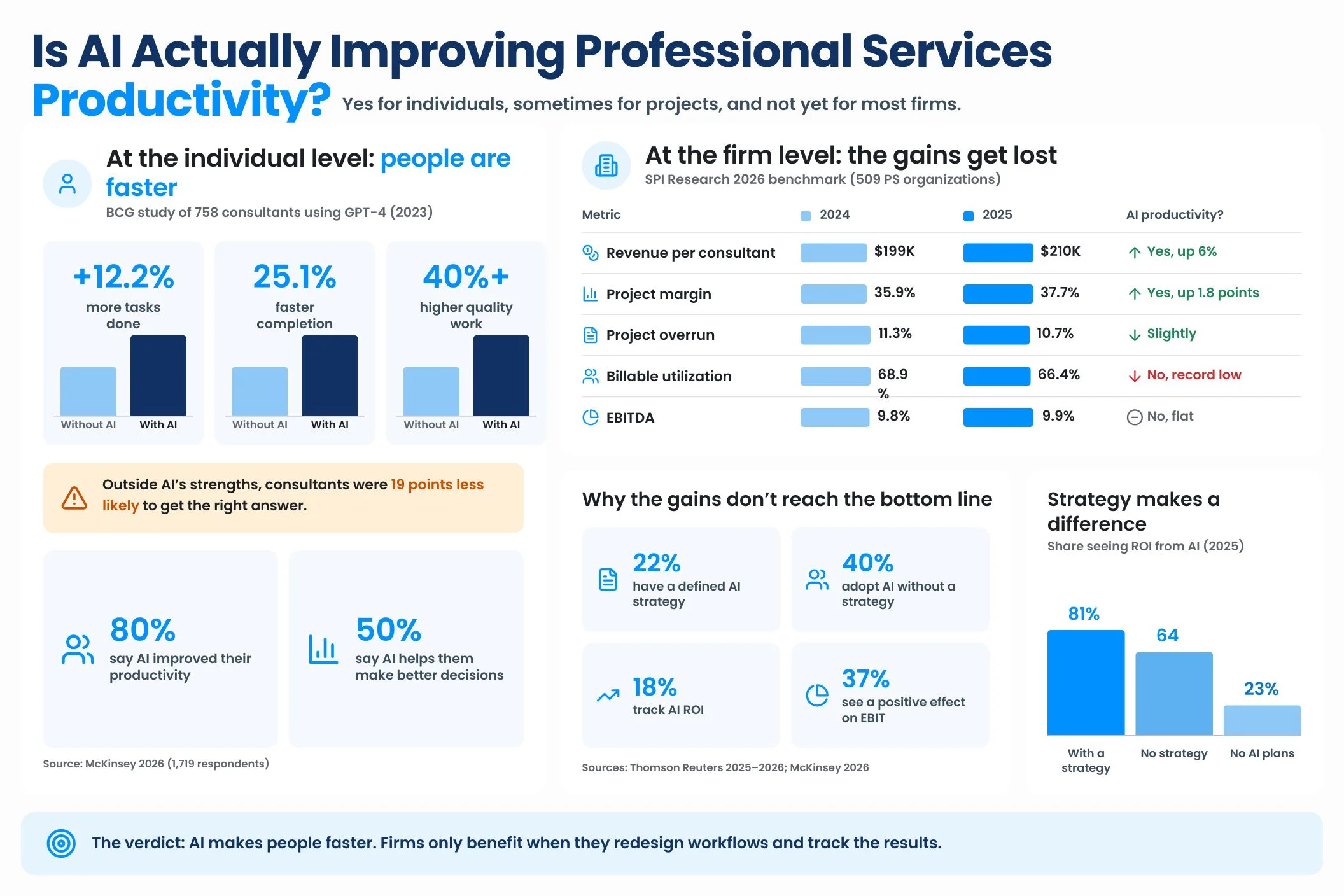
Short answer: yes for individuals, sometimes for projects, and not yet for most firms. The closer you get to the bottom line, the harder the gains are to find.
At the individual level: people are faster
The strongest evidence comes from a controlled study. In 2023, Harvard Business School and Boston Consulting Group tested GPT-4 with 758 BCG consultants on realistic consulting tasks.
On tasks that suited AI, consultants using it:
- Completed 12.2% more tasks
- Finished 25.1% faster
- Produced work rated more than 40% higher in quality
But on a task that fell outside what AI could do well, consultants using it were 19 percentage points less likely to get the right answer than those working without it. The researchers called this the “jagged frontier”: AI is excellent at some tasks and confidently wrong at others, and it’s not always obvious which is which.
Professionals report the same kind of gain. In McKinsey’s 2026 State of AI survey (1,719 respondents across all industries), 80% said AI improved their individual productivity, and 50% said it helps them make better decisions.
At the firm level: the gains get lost
If each person is faster, firm results should improve. SPI Research’s 2026 benchmark (509 PS organizations, 2025 data) shows a mixed picture:
| Metric | 2024 | 2025 | Does it show AI productivity? |
|---|---|---|---|
| Revenue per consultant | $199K | $210K | ✅ Yes, up 6% |
| Project margin | 35.9% | 37.7% | ✅ Yes, up 1.8 points |
| Project overrun | 11.3% | 10.7% | ✅ Slightly |
| Billable utilization | 68.9% | 66.4% | ❌ No, record low |
| EBITDA | 9.8% | 9.9% | ❌ No, flat |
Source: SPI Research 2026 benchmark, via Deltek
Projects are running a bit more efficiently, and each consultant brings in more revenue. But people are billing less of their time, and profit hasn’t moved. The hours AI saves aren’t being turned into more client work or lower costs.
Why the gains don’t reach the bottom line
The biggest reason is simple: most firms aren’t managing AI as a business investment.
| Finding | Result | Source and population |
|---|---|---|
| Organizations with a visible, defined AI strategy | 22% | Thomson Reuters, 2,275 professionals, 2025 |
| Organizations adopting AI without a strategy | 40% | Thomson Reuters, 2,275 professionals, 2025 |
| Respondents who know their organization tracks AI ROI | 18% | Thomson Reuters, 1,500+ professionals, 2026 |
| Organizations reporting AI had a positive effect on EBIT | 37% | McKinsey, 1,719 respondents across all industries, 2026 |
Strategy makes a clear difference. In Thomson Reuters’ 2025 survey, the share of professionals seeing ROI from AI was:
- 81% at organizations with an AI strategy
- 64% at organizations adopting AI without a strategy
- 23% at organizations with no AI plans
Organizations with an AI strategy were also twice as likely to see revenue growth from AI.
So, is AI improving productivity?
For individual professionals, yes, and the evidence is solid. For firms, only when they change how they work: redesigning workflows, filling the saved time with client work, and tracking the results. Right now, most firms are getting faster people without getting a better business.
AI Adoption vs. Billable Utilization
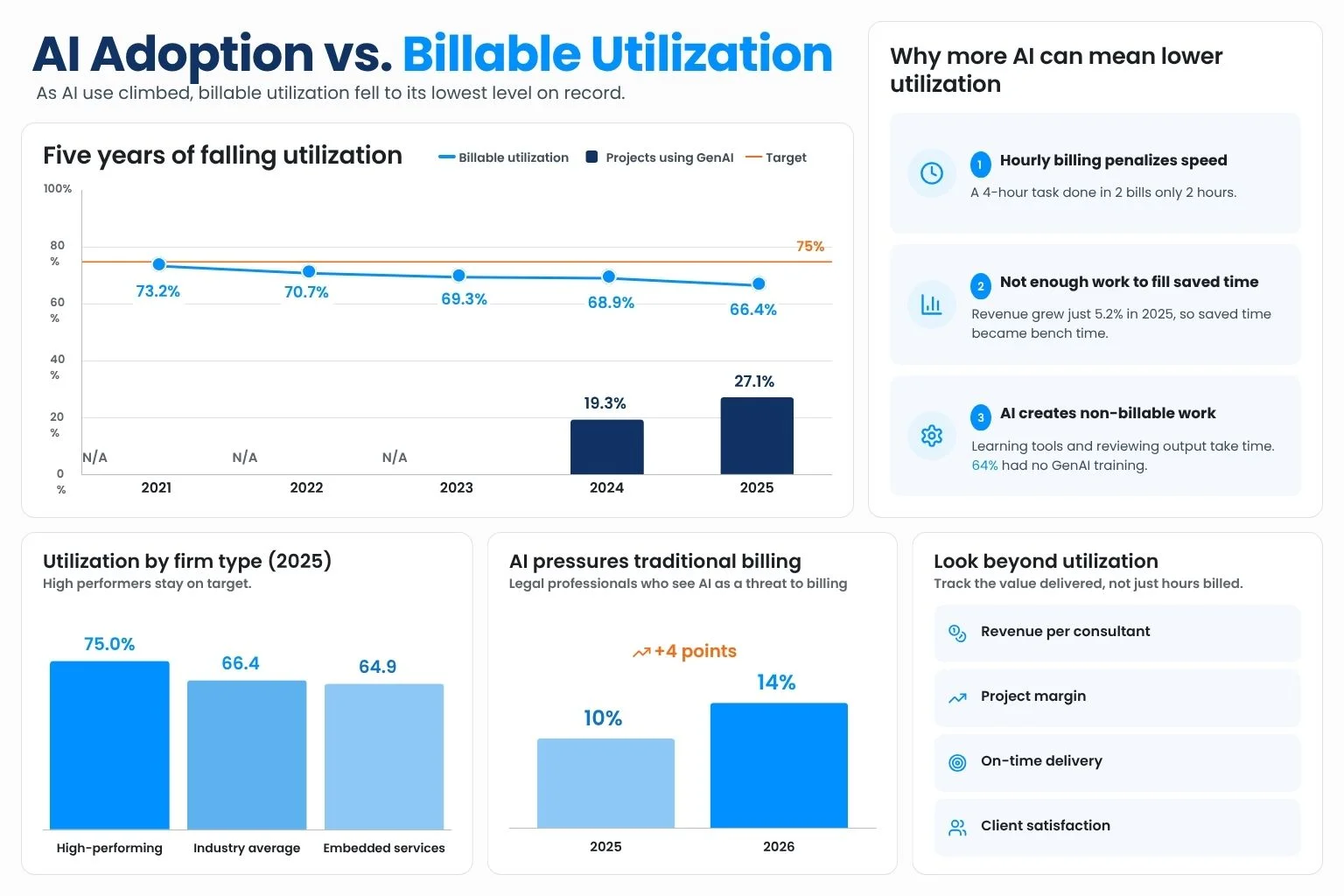
This is the part of the story that doesn’t add up at first. AI is supposed to free up time. Yet as AI use climbed, billable utilization kept falling to its lowest level on record.
Five years of falling utilization
| Year | Billable utilization | Projects using GenAI |
|---|---|---|
| 2021 | 73.2% | Not tracked |
| 2022 | 70.7% | Not tracked |
| 2023 | 69.3% | Not tracked |
| 2024 | 68.9% | 19.3% |
| 2025 | 66.4% | 27.1% |
SPI considers 75% the optimal utilization target. Sources: 2021, 2024, 2025 from SPI Research 2026 benchmark, via Deltek; 2022 and 2023 from SPI Research 2024 benchmark
Two things stand out. First, utilization was already falling before GenAI took off. It dropped almost 4 points between 2021 and 2023, before SPI started tracking AI use. So AI didn’t start this trend. Second, the steepest one-year drop in the table (2.5 points) came in 2025, the same year project-level AI use grew 40%.
Why more AI can mean lower utilization
1. Hourly billing works against faster work
If a consultant finishes a task in 2 hours instead of 4, a time-and-materials project bills 2 hours instead of 4. Unless that saved time goes into other client work, utilization drops. Revenue per consultant still rose 6% in 2025 (from $199K to $210K), which suggests each billed hour is worth more, even as there are fewer of them.
2. There isn’t enough client work to fill the saved time
Revenue grew just 5.2% in 2025, below the 8.0% five-year average. Headcount grew 2.8%. When demand is soft, time saved by AI turns into bench time, not billable time.
3. AI creates its own non-billable work
Learning new tools, testing prompts, reviewing AI output, and setting up policies all take time, and none of it is billable. In 2025, Thomson Reuters found 64% of professionals had received no GenAI training at work (1,700+ professionals, US, UK, and Canada), so many people are figuring it out on their own time.
The best firms keep utilization high
Not every firm is sliding. In SPI’s 2026 benchmark, high-performing organizations held utilization at 75.0%, right on target, while embedded services organizations fell to 64.9%.
| Group (SPI, 2025 data) | Billable utilization |
|---|---|
| High-performing organizations | 75.0% |
| Industry average | 66.4% |
| Embedded services organizations | 64.9% |
Source: SPI Research 2026 benchmark, via Rocketlane
The difference isn’t just AI. It’s what firms do with the time AI gives back. High performers move that time into more client work, better scoping, and new services. Others let it leak into admin.
Is utilization still the right metric?
Utilization measures how much time people bill, not how much value they deliver. In a world where AI makes work faster, a firm can deliver the same result in fewer hours and look worse on paper.
That’s why many firms are starting to track outcome-based metrics alongside utilization:
- Revenue per consultant
- Project margin
- On-time delivery
- Client satisfaction
Firms still billing by the hour are also feeling this pressure. In the Thomson Reuters 2026 report, the share of legal respondents who see AI as a threat to billing and revenue rose from 10% to 14%.
What Professional Services Firms Are Doing With AI
Firms aren’t just handing out ChatGPT logins anymore. The more advanced ones are turning AI into something they sell, testing AI agents, and responding to what clients want. The catch: the basics, like policy, training, and pricing, are still behind.
At a glance: where firms are acting and where they’re lagging
| Area | What firms are doing | Source and population |
|---|---|---|
| Selling AI services | ✅ 40% of firms sell AI-related services | SPI Research, 509 PS organizations, 2025 data |
| Agentic AI | ✅ 15% use agentic AI, 53% are planning or considering it | Thomson Reuters, 1,500+ professionals, 2026 |
| AI tools | ✅ 55% of legal teams use general-purpose AI tools, 38% enterprise tools like Copilot, 35% specialized legal tools | Thomson Reuters 2026 legal findings, via NY Daily Record |
| AI policy | ❌ Only 9% of law firms have a written, enforced AI policy | 8am, 1,300+ legal professionals, 2026 |
| Training | ❌ 54% of law firms offer no training on responsible AI use | 8am, 1,300+ legal professionals, 2026 |
1. Turning AI into a new service line
For many firms, AI is now something they sell as well as use. SPI Research found that 40% of professional services firms now offer AI-related services, such as helping clients choose, set up, or govern AI tools.
This matters because it adds a new revenue stream at a time when core revenue growth is slow (5.2% in 2025). Firms that built AI skills internally first have an easier time selling them.
2. Moving from AI assistants to AI agents
GenAI tools help people do tasks. Agentic AI can carry out multi-step tasks on its own. Adoption is still early, but expectations are high: in 2026, 77% of professionals expected agentic AI to be central to their workflow by 2030.
In legal specifically, 16% of respondents already use agentic AI, and another 19% plan to. Corporate tax departments are also ahead of the average on agentic AI adoption.
3. Responding to client pressure (and mixed signals)
Clients want their firms to use AI, but they’re not always clear about it. From Thomson Reuters’ 2026 report:
- Two-thirds of corporate respondents want their outside firms to use AI
- Fewer than 20% actually require it
- Less than one-third know whether their firms use AI at all
- 40% of firm respondents get conflicting instructions from clients, with some asking them to use AI and others asking them not to
Clients also aren’t pushing hard on price yet. In 8am’s 2026 survey, only 6% of legal professionals said clients explicitly asked for AI-linked cost reductions.
💡 Tip
Don’t wait for clients to ask. Tell them how you use AI, what it does, and how you check its output. Firms that explain their approach up front avoid the “should we or shouldn’t we” confusion and build trust at the same time.
4. Keeping pricing mostly the same
Most firms haven’t changed how they charge, even as AI speeds up their work. Clio’s 2026 legal trends research found:
| Firm size (Clio, 2026) | AI adoption | Haven’t changed pricing |
|---|---|---|
| Solo practitioners | 71% | 86% |
| Small firms | 75% | 78% |
Source: Clio 2026, via North Carolina Bar Association
So most small law firms use AI, but very few have changed pricing to match. That links back to the utilization problem: faster work billed by the hour means fewer billable hours.
5. Lagging on policy and training
This is the biggest gap. Firms are adopting AI faster than they’re managing it:
- 52% of professionals say their organization has no GenAI policy (Thomson Reuters, 1,700+ professionals, 2025)
- 43% of law firms have no formal AI policy and no plans to create one (8am, 1,300+ legal professionals, 2026)
- 72% of tax firms don’t offer GenAI training (Thomson Reuters, tax professionals, 2025)
💡 Tip
You don’t need a 30-page policy to start. One page that lists approved tools, what client data can’t go into them, and who reviews AI output closes the gap most firms still have.
AI Adoption in Professional Services: What to Expect in 2027 and Beyond
If the last two years were about trying AI, the next two will be about making it pay. Here’s where the data points.
1. Adoption will keep growing, and agents will lead the next wave
Agentic AI is where the next jump will come from, and large companies are moving first. In McKinsey’s 2026 survey (1,719 respondents across all industries), 40% of organizations with more than $1 billion in revenue are scaling AI agents, up from 27%. Only 22% of smaller organizations are doing the same. AI is also spreading across more of the business: 56% of respondents say their organization uses AI in three or more functions, up from 51%.
What to expect: Agentic AI will go from pilot projects to real client work, starting with large firms and repeatable, multi-step tasks like research, document review, and reporting.
2. The focus will shift from “Are we using AI?” to “Is it paying off?”
Even the firms that measure AI mostly measure the wrong things. In Thomson Reuters’ 2026 report, 77% of organizations that track AI ROI look only at internal metrics like cost savings and employee usage, and 40% of respondents aren’t sure how to measure ROI at all. That won’t last. As AI costs grow, leaders will want proof.
McKinsey also found that about 20% of respondents say AI operating costs already limit how much they use it.
What to expect: More firms will track AI against business results, like margin, revenue per consultant, and on-time delivery, instead of just counting users and logins.
3. Pricing models will start to change, slowly
Hourly billing and faster work don’t mix well. There’s already a small margin edge for fixed pricing: in SPI’s 2025 data (509 PS organizations), fixed-price projects earned a 37.2% margin, compared to 36.4% for time-and-materials projects. As AI speeds up delivery, that gap is likely to grow.
What to expect: More fixed-fee and outcome-based pricing, starting with work AI speeds up the most. Firms that move early will keep the time AI saves as margin. Firms that don’t will keep watching utilization fall.
4. Workforce changes will be smaller than predicted, for now
Fears about AI replacing jobs are high, but actual cuts have been limited. In McKinsey’s surveys (all industries):
| Share of respondents | |
|---|---|
| Expected AI-driven headcount cuts in the past year (predicted in 2025) | 32% |
| Actually saw AI-driven headcount cuts (reported in 2026) | 14% |
| Expect AI-related workforce declines in the coming year (2026) | 39% |
Source: McKinsey, The state of AI 2026 (1,719 respondents across all industries)
What to expect: Roles will change faster than headcount. Junior work like research and first drafts will shrink, and firms will need to rethink how they train new people when those tasks go to AI.
⚠️ Note
Forecasts in AI have a poor track record, including the one above: fewer than half of the expected job cuts actually happened. Treat every prediction in this section as a direction, not a guarantee.
Three lessons from the data
1. How you use AI matters more than whether you use it. Firms that use AI widely earn 17.9% EBITDA, compared to 6.0% for non-users. Most firms are stuck in between, using AI on a few tasks without changing how the work gets done.
2. Saved time only counts if it goes somewhere. High-performing firms kept utilization at 75.0% while the industry fell to 66.4%. The difference is what happens to the hours AI frees up: more client work, or more admin.
🚀 How TaskFord helps
You can’t redirect saved time if you can’t see it. TaskFord puts time tracking, resource planning, and project profitability in one place, so you can see where the hours AI frees up actually go, spot who has room for more client work, and check whether margins improve as a result. No more guessing from five different spreadsheets.
3. A strategy turns AI from a cost into a return. 81% of organizations with an AI strategy see ROI, compared to 23% of those with no AI plans. Only 22% have a defined strategy.
Frequently Asked Questions About AI Adoption in Professional Services
What are the biggest risks of using AI in professional services?
Accuracy is the biggest concern. In Thomson Reuters’ 2025 Future of Professionals survey (2,275 professionals), 91% said AI should meet a higher accuracy standard than humans, and 41% said AI output must be 100% accurate before it can be used without review. Other major risks are exposing confidential client data, relying on AI output that nobody checked, and unclear accountability when something goes wrong.
How much time will AI save professionals in the long run?
Professionals expect the savings to grow a lot. In Thomson Reuters’ 2024 Future of Professionals survey (2,200+ professionals in legal, tax, and risk and compliance), respondents expected AI to save them 12 hours per week within five years. That’s about a day and a half of every work week.
Will AI make it harder for junior staff to learn?
It can. Research, first drafts, and document review are how junior professionals build skills, and those are the tasks AI takes over first. In Thomson Reuters’ 2025 survey, 25% of professionals worried that relying on AI could hold back professional development. Firms can manage this by having junior staff review and correct AI output, so they still learn the work, rather than skipping it.
Should firms use general AI tools or industry-specific ones?
Most professionals prefer tools built for their field. In Thomson Reuters’ 2025 survey, 88% said they want profession-specific AI assistants. General tools like ChatGPT are great for drafting and brainstorming. Industry-specific tools are usually better for work that needs reliable sources, like legal research or tax guidance.
How should firms protect client data when using AI?
Start with clear rules on what can and can’t go into an AI tool. Use enterprise versions that don’t train on your data, keep confidential client information out of public tools, and check each vendor’s data storage and security terms. Make sure the rules are written down and that everyone has been trained on them, not just the IT team.
Should firms tell clients they use AI?
Yes. Telling clients how you use AI, which tasks it handles, and how you check the output builds trust and avoids surprises later. It also helps you agree on expectations up front, such as whether AI savings should affect pricing or whether some clients want AI kept off their work.
What skills do professionals need to work well with AI?
Three skills matter most: knowing which tasks AI handles well, writing clear instructions, and reviewing output critically. The last one is the most important. AI can produce confident answers that are wrong, so the value of an expert shifts from doing the first draft to judging whether the draft is right.
Read Also:
Related Articles








![Professional Services Project Plan Template [Free Excel Download]](/marketing/blog/professional-services-project-plan-template-free-excel-download.webp)



Subscribe for Expert Tips
Unlock expert insights and stay ahead with TaskFord. Sign up now to receive valuable tips, strategies, and updates directly in your inbox.